June 17, 2026
Stop drowning your sales reps in low-quality 'tech-stack change' alerts. The common advice to 'be a detective' fails when reps are managed with factory-worker activity metrics, leading to burnout. This guide provides a systematic approach to fixing this broken model. Learn how to define high-value 'golden signals,' leverage AI to eliminate noise, and equip your team with complete narratives, not just data points, to initiate meaningful sales conversations and generate real pipeline.
Here’s the insane contradiction at the heart of modern sales management.
We tell our reps to be Sherlock Holmes. "Be a detective," we say. "Investigate every tech-stack change, connect the dots, understand the buyer's world, and craft a bespoke, deeply insightful message." We show them slides about strategic selling and consultative approaches.
Then we manage them like Amazon warehouse workers. We chain them to a dashboard that screams "80 DIALS A DAY OR YOU'RE FIRED." We measure their worth in raw activity volume. Clicks, emails sent, calls made. Low-cognition, repetitive factory work.
This cognitive dissonance isn't a quirky management style. It's a burnout factory.
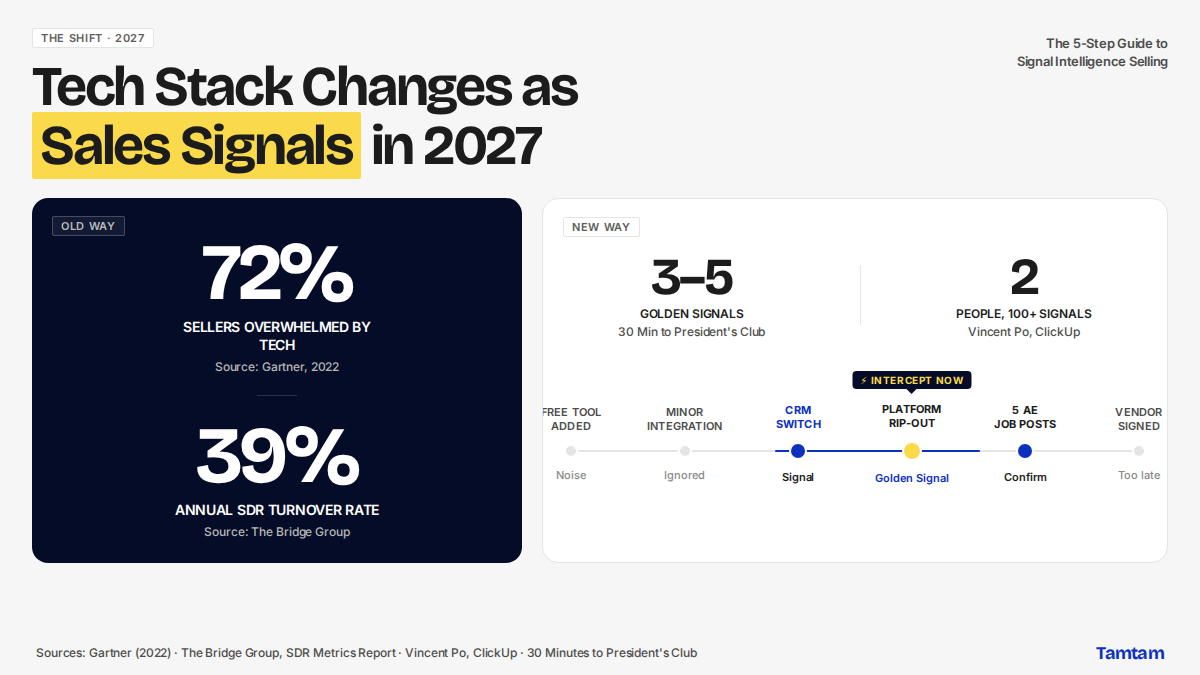
And the numbers prove it. Gartner found that a staggering 72% of B2B sellers feel overwhelmed by the amount of tech they have to use. The Bridge Group reports that the average annual turnover for an SDR is a horrifying 39%. That's not just a line item on an HR report. That's a revolving door of talent costing you well into six figures in hiring and training costs every time a good rep quits because they couldn't handle the schizophrenia of the job.
This is not a motivation problem. It's a systems problem. The math is broken.
The solution isn't to force your reps to become better detectives while also being faster factory workers. That’s impossible. The solution is to get them out of the detective business altogether. It’s time to build a system that lets machines do the soul-crushing forensic grunt work so your expensive human reps can focus on actual selling. A tech-stack change is one of the highest-signal buying signals out there, once you filter the noise.
First things first: most tech signals are useless noise. Drowning your team in a sea of low-grade alerts is lazy leadership, and it’s the fastest path to "signal fatigue," where reps just start ignoring everything.
Why this matters: Your reps' attention is your most valuable and finite resource. Wasting it on meaningless data points is like asking a master chef to spend their day peeling potatoes with a teaspoon. A "golden signal" is a tech change that screams strategic intent. It implies a major initiative, a newly allocated budget, or a deep-seated pain you are uniquely qualified to solve.
What to do: Get your sales, marketing, and product teams in a room. Look at your last 20 closed-won deals. What was the real catalyst? Was it just that they hired a new VP? Or was it that they hired a new VP and ripped out a major competitor's platform and posted five new job descriptions mentioning a skill your product enables?
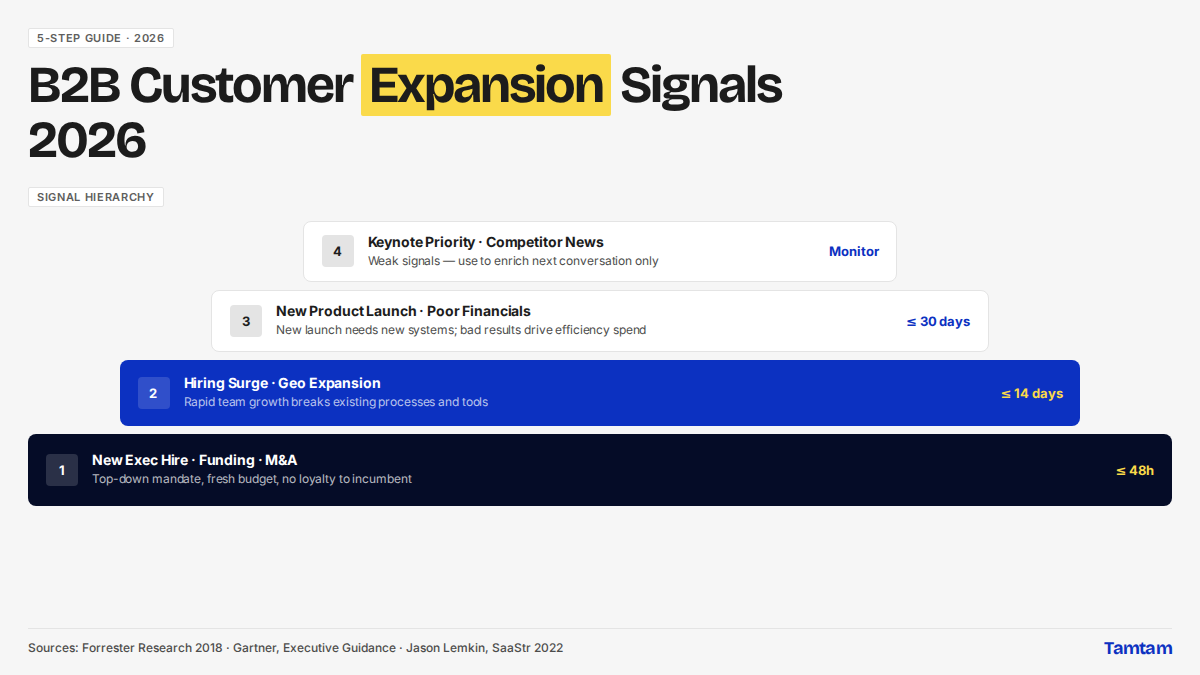
Identify the 3 to 5 patterns of tech changes that genuinely correlate with a prospect being ready to buy. These are your Golden Signals. Everything else is garbage.
A concrete example:
Common mistake to avoid: Buying a data tool and just telling your reps to "go find the good stuff." That’s abdicating your responsibility as a leader. Your job is to define the strategy and give them a clean, focused list of targets, not a messy digital phone book.
Once you know what you’re looking for, you need a way to find it at scale without turning your reps into bloodshot-eyed data miners. A human cannot, and should not, manually sift through thousands of accounts every day looking for a handful of golden signals. It's economically insane and psychologically destructive.
Why this matters: This is a job for a machine. An "AI Forensics Unit" is a system, not necessarily a single tool, that automatically monitors your entire target market for only your predefined golden signals. It’s your signal intelligence engine, working 24/7.
What to do: Automate the monitoring. This could be a combination of data providers, custom scripts, or a dedicated platform. The goal is to create a workflow where the firehose of raw data is filtered down to a mere trickle of high-value alerts before it ever touches a human. The machine's job is to throw out 99.9% of the data to find the 0.1% that matters.
A concrete example: The team at ClickUp didn't scale their outbound by hiring an army of 40 SDRs to manually research accounts. Instead, a tiny team of two people managed what they called a "programmatic pipegen" system. This system automatically monitored over 100 different signals across their target market. The vast majority of signals were automatically discarded. Only the golden ones, the ones that indicated a company was a perfect fit at the perfect time, were packaged and passed to a human for a high-touch, personalized follow-up.
Common mistake to avoid: Buying an expensive intent data subscription and plugging the raw feed directly into your reps' Salesforce view or Slack channel. Congratulations, you’ve just given your highly-paid sellers a second job as a data analyst, a job they are not trained for, are not good at, and actively hate doing.
Okay, so your AI Forensics Unit found a golden signal. Its job isn't over. A raw data point is not an opportunity. It’s just a clue. The next step is for the system to act like a paralegal and assemble a complete "case file" or "deal summary" for the rep.
Why this matters: Context is everything. A rep's time is too valuable to spend 30 minutes piecing together the story behind an alert. The machine should do that in seconds. The goal is to arm the rep with a complete narrative, not just a fact.
What to do: Your system must be configured to answer the question, "So what?" When a signal is triggered, the system should automatically pull in related data points. Who is the new VP of Sales? Where did they work before? What tools did they use there? Are there relevant job postings? Recent company news? (A new exec is a job-change signal; those open roles are hiring signals.) All this context should be synthesized into a short, digestible brief.
A concrete example:
SaaStr founder Jason Lemkin has talked about their internal AI, "Amelia," which does exactly this. It delivers a full "buyer brief" directly into Slack, telling the team not just what happened, but why it matters and who to talk to.
Common mistake to avoid: Sending reps context-free alerts that force them to open 10 different browser tabs to figure out what the hell is going on. Every minute they spend doing basic research is a minute they aren't talking to a potential customer.
Now, finally, the human gets involved. The rep receives the case file. Their job is not to parrot back the data. It's to use the insights to start a conversation about the buyer's implied problem.
Why this matters: Leading with "I saw you installed Gong" is creepy. It screams, "I am watching you." It turns you from a potential partner into a digital stalker. Leading with the problem that Gong is meant to solve, however, positions you as a strategic expert who understands their world.
What to do: Coach your reps to use the case file to build a "Trojan Horse" message. The signal is the Trojan Horse that gets you past the gates, but the value is what's inside. The outreach should focus entirely on the strategic challenge the prospect is likely facing.
A concrete example:
This message shows you've done your homework without being weird about it. It demonstrates empathy and expertise. You're not selling a product; you're starting a conversation about their most pressing business problem.
Common mistake to avoid: Reps getting lazy and just mentioning the signal itself as their personalization token. The signal is the reason for the outreach, not the content of the outreach.
If you follow the first four steps, your old activity metrics become worse than useless. They become actively harmful. You have built a system to arm a team of snipers, but you are still measuring them like a machine-gun squad. This will kill the entire initiative.
Why this matters: You get what you measure. If you continue to reward raw, mindless activity, your reps will be forced to ignore the high-quality, low-volume signals from your new system and go back to spamming low-quality lists to hit their dial count. The system will fail not because it's bad, but because your management of it is.
What to do: Change your KPIs. Your new dashboard should track effectiveness, not just effort. Measure what actually contributes to revenue.
Concrete examples of new KPIs:
Common mistake to avoid: The classic "but we've always done it this way." Keeping volume-based KPIs while asking for quality-based work is the definition of insanity. It creates a culture of conflict and guarantees your best reps will leave for a company that knows how to manage a modern sales floor.
The mindset shift here is simple but profound. Stop asking your creative, empathetic, and very expensive human sellers to do shitty, repetitive, low-cognition machine work. The goal is no longer to simply work harder; it's to build a system with insane leverage. It requires trusting that a machine can handle the forensic grunt work better than a human ever could, freeing your reps to focus on the messy, chaotic, and uniquely human work of building trust and closing deals. Building this kind of system is what separates good sales teams from the ones that will dominate the next decade. And platforms like Tamtam are designed around this exact philosophy: delivering the ready-to-work case files that let your reps stop researching and start selling.
Set up for you before our first call
Book a demo