June 4, 2026
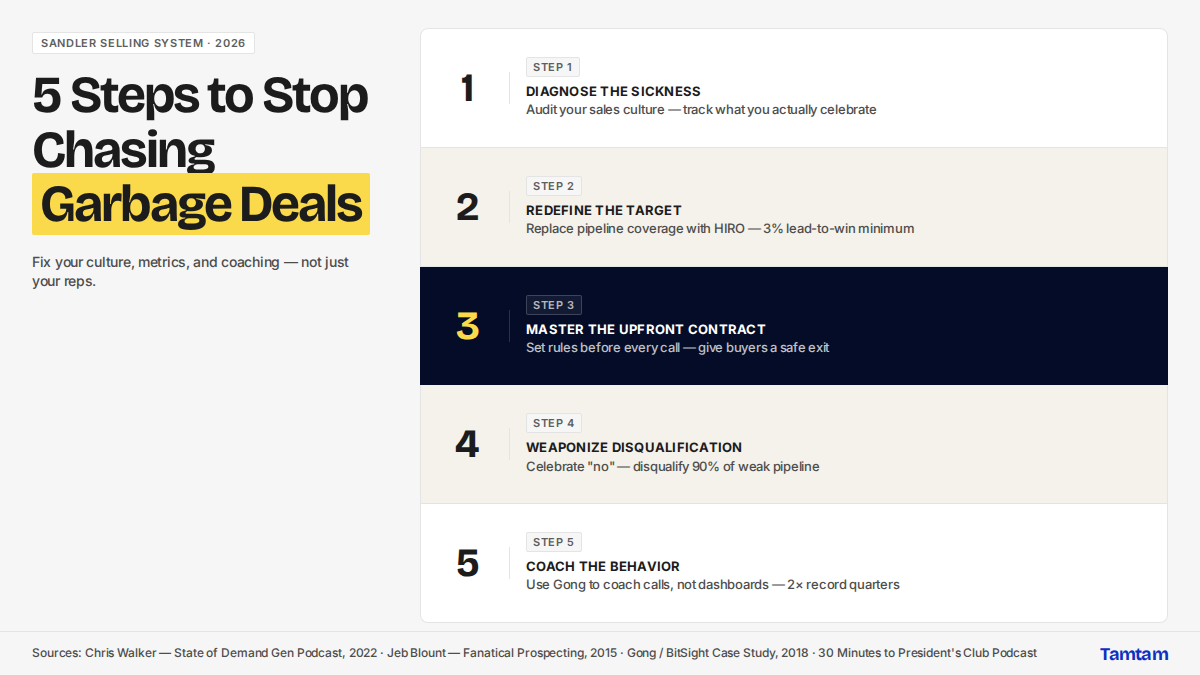
Most Sandler implementations fail not because of reps, but because the company rewards the wrong behavior. This guide explains how to make the Sandler Selling System actually work by fixing the broken system around it. You'll learn to replace vanity metrics like pipeline coverage, make disqualification a celebrated KPI, and coach real sales behaviors instead of just CRM reports. It''s time to stop performing sales theater and start closing real, qualified deals.
You’ve been told to practice Sandler’s “radical detachment.” You’ve learned the submarine analogy, you’ve practiced “reversing,” and you know you’re supposed to “go for the no.”
But then you walk into your Monday sales meeting, and your manager is breathing down your neck about hitting 4x pipeline coverage and making 150 dials a day. Your compensation plan screams "close anything," while your training manual whispers "disqualify ruthlessly."
This cognitive dissonance is why most Sandler implementations fail spectacularly. Reps nod along in the training, then go right back to their old habits because the system they work in punishes honesty and rewards optimism.
The real enemy of the Sandler Selling System isn't the buyer's objections. It's your manager's dashboard. It's the board meeting that demands to see a fat pipeline, regardless of its quality. It’s a culture that says one thing and measures another.
So, let's fix that. This isn't another guide about the Sandler Submarine. This is a guide to re-architecting your sales environment so that this brilliant methodology, like any of the popular sales methodologies you've tried before, can actually, finally, work.
Before you can fix anything, you have to stare the ugly truth in the face. You need to conduct a brutal, unflinching audit of what your sales culture actually rewards, not what the motivational posters on the wall say it rewards.
Why this matters: You can't fix a problem you refuse to see. Most sales leaders think they have a "rep problem" when they really have a "system problem." Realizing that your obsession with a 4x pipeline is actively costing you money is the necessary slap in the face. It’s the first step to recovery.
What to do:
For one week, get forensic. Ask your reps to track their time, or better yet, do it for them with calendar and activity analysis. Specifically, measure two things:
Let’s put a price tag on that second point. A 50-rep team where each rep wastes just 4 hours a week on dead pipeline management, at an average loaded cost of $75/hour, is burning through cash.
50 reps x 4 hours/week x 48 weeks/year x $75/hour = $720,000 per year.
That’s over half a million dollars, lit on fire, to maintain a comfortable fiction in your CRM. Presenting this number to your leadership team is how you get permission to change.
Example: Meet Sarah, a solid B-player AE. She has a $100k deal in her pipeline with a prospect who has gone completely dark. She knows it’s a bad fit. The budget isn't really there, and the champion is a junior manager with no power. But her pipeline coverage is at 2.8x, and her manager is getting nervous. So, she spends an hour crafting a "just checking in" email, logs it in the CRM, and moves the close date out another 30 days. The dashboard stays green. Her manager is happy for another week. And the sickness spreads.
Common mistake to avoid: Blaming individual reps for having "happy ears" or "commission breath." This is a lazy diagnosis. They are rational actors responding to the incentives you created. If your system rewards them for keeping Sarah's ghost deal alive, they will keep it alive. The problem isn’t the player; it’s the game.
Once you’ve diagnosed the sickness, you need to change the metric that causes it. The concept of "pipeline coverage" is the root of all evil in modern B2B sales. It incentivizes the exact behavior you’re trying to eliminate: stuffing the pipeline with low-probability junk.
Why this matters: Replacing a vanity metric with a reality-based one mathematically removes the incentive to lie. It aligns daily sales activity with the company's actual revenue goals. It’s the single fastest way to force your team to think like ruthless disqualifiers, because the math leaves them no other choice.
What to do:
Kill the pipeline coverage KPI. Immediately. In its place, install Chris Walker’s HIRO (High Intent Revenue Opportunity) Pipeline metric. It’s simple and brilliant.
A deal only qualifies for HIRO Pipeline if it meets two strict criteria:
Everything else is not pipeline. It’s a lead. It’s a conversation. It’s prospecting. But it does not count toward the forecastable pipeline that leadership cares about. As sales legend Jeb Blount argues, you must separate your "list leads" from real, qualified "First Time Appointments" (FTAs) with buyers who have a genuine need.
Example: Under the old model, a cold outbound email that gets a vague "sure, send me info" reply might get logged as a $50k opportunity at the "Discovery" stage. Pipeline coverage goes up. Yay. Under the HIRO model, that opportunity is worth $0 to the pipeline metric until that buyer has confirmed budget, authority, and need, and has advanced to a stage like "Mutual Action Plan," which you know converts at 30%. The pressure to get real is immense.
Common mistake to avoid: Doing this in a silo. You can't just change your team's dashboard and hope for the best. You must evangelize this change up to your board and CEO. Frame it not as "making our pipeline smaller," but as "making our forecast more accurate." You’re trading bloated, unpredictable optimism for a smaller, data-driven, and far more predictable revenue engine.
With the cultural and metric-based foundations in place, you can now focus on the core tactical element of the Sandler System: the Upfront Contract. This is not a "nice to have" or a "sometimes" tool. It is the non-negotiable price of admission for every single sales conversation.
Why this matters: The Upfront Contract fundamentally resets the power dynamic. It moves the salesperson from a needy, approval-seeking "Child" ego state to a calm, consultative "Adult" ego state, to use Sandler's transactional analysis terms. It gives you permission to be a diagnostician, not a peddler. And crucially, it gives the buyer a safe, easy, pressure-free way out, which, paradoxically, makes them trust you more and feel more comfortable staying.
What to do:
Drill the Upfront Contract until your reps can do it in their sleep. It must be established at the beginning of every call, meeting, and interaction. It has five simple parts:
That last part is the fucking magic bullet. It’s the pattern interrupt. It signals to the buyer that you are not desperate and that you respect their time.
Example:
Common mistake to avoid: Saying the words but not meaning them. The Upfront Contract is an ethos, not just a script. If you set the contract but then get scared and revert to aggressive pitching the moment a buyer shows hesitation, you've failed the test. You have to be genuinely willing to hear "no" and end the conversation.
You’ve set the stage. You’ve changed the metrics. You’ve mastered the contract. Now comes the most important cultural shift of all: you must actively, loudly, and publicly celebrate the act of disqualifying bad-fit deals.
Why this matters: Culture is defined by what you celebrate. As long as reps feel even a tiny bit of shame or fear for shrinking their pipeline, they will continue to hoard garbage deals. By making disqualification a heroic act, you give your team the psychological safety they need to be brutally honest about their pipeline and focus their energy where it matters most.
What to do:
Change the script in your weekly sales meetings.
Put a bounty on it. Create a Slack channel called #goodbye-garbage where reps post screenshots of deals they’ve closed-lost as "Not a Fit" and explain the reasoning. The rep who disqualifies the most garbage revenue each month gets a bonus or a prize. Make it a competition. Turn pipeline hygiene from a chore into a sport.
This aligns with the philosophy from the sales podcast 30 Minutes to President's Club, which advocates for disqualifying 90% of your weak pipeline. The rep who kills a shaky $100k "maybe" deal to free up 10 hours for prospecting a real $50k deal is the hero of this story, not the slacker.
Example: In the Monday meeting, your rep Alex stands up. "I DQ'd the Acme Corp deal for $150k," she says. "After three conversations, it was clear their tech stack was incompatible and the economic buyer was stringing us along. Killing it now saves us a dozen hours of wasted demo prep and frees me up to go after three new accounts that fit our ICP perfectly." The sales leader should respond with, "Excellent. That’s exactly the kind of disciplined decision that wins us the quarter. Who’s next?"
Common mistake to avoid: Punishing an honest rep, even once. The first time you criticize a rep for their pipeline shrinking after they honestly disqualified a deal, you destroy all the trust you’ve built. The entire team will see it and immediately revert to hiding their bad deals. You have to be consistent.
Finally, you have to change how you manage. If your entire coaching process revolves around staring at a CRM dashboard and asking, "Is this deal going to close?", you are part of the problem. You are managing data entry, not coaching salespeople.
Why this matters: You get what you measure. If you only measure pipeline value and close dates, reps will optimize for making those two fields look good. If you measure the quality of their discovery questions and the execution of their Upfront Contracts, they will optimize for becoming better salespeople. This is how you make the training stick.
What to do:
Use a revenue intelligence platform to listen to actual call recordings. Stop managing the CRM and start coaching the conversation. Build a simple scorecard based on the Sandler behaviors you want to see.
Your 1:1s should be spent reviewing call snippets and coaching these specific behaviors. This is how you turn theory into practice. A great example is BitSight Technologies. They invested in Sandler training and paired it with Gong to measure if reps were actually using the methodology. They coached to the behaviors, not the reports. The result? Two record-breaking quarters in a row.
Common mistake to avoid: Buying a fancy revenue intelligence tool but using it as a surveillance device. If you just use it to micromanage and "catch" reps making mistakes, they'll resent it. You have to frame it, and use it, as a genuine coaching tool for their development. The goal is to make them better, not to make them paranoid.
The real promise of the Sandler System isn't a set of tricks to manipulate buyers. It’s about transforming the salesperson from a desperate peddler into a respected diagnostician, and that can't happen if reps are terrified of a shrinking pipeline. Getting comfortable with disqualification is easy when your list is full of high-quality opportunities to begin with. The game inside the game is that great sellers don't just qualify better; they start with a better list. When your front-end research is as disciplined as your sales calls, you build an engine that surfaces accounts with genuine buying triggers. That confidence is what allows a sales team to ruthlessly disqualify everything else. It's the whole idea behind platforms like Tamtam: turning deep, continuous research on your entire market into a prioritized list so reps can spend their time selling, not searching.
Set up for you before our first call
Book a demo