June 4, 2026
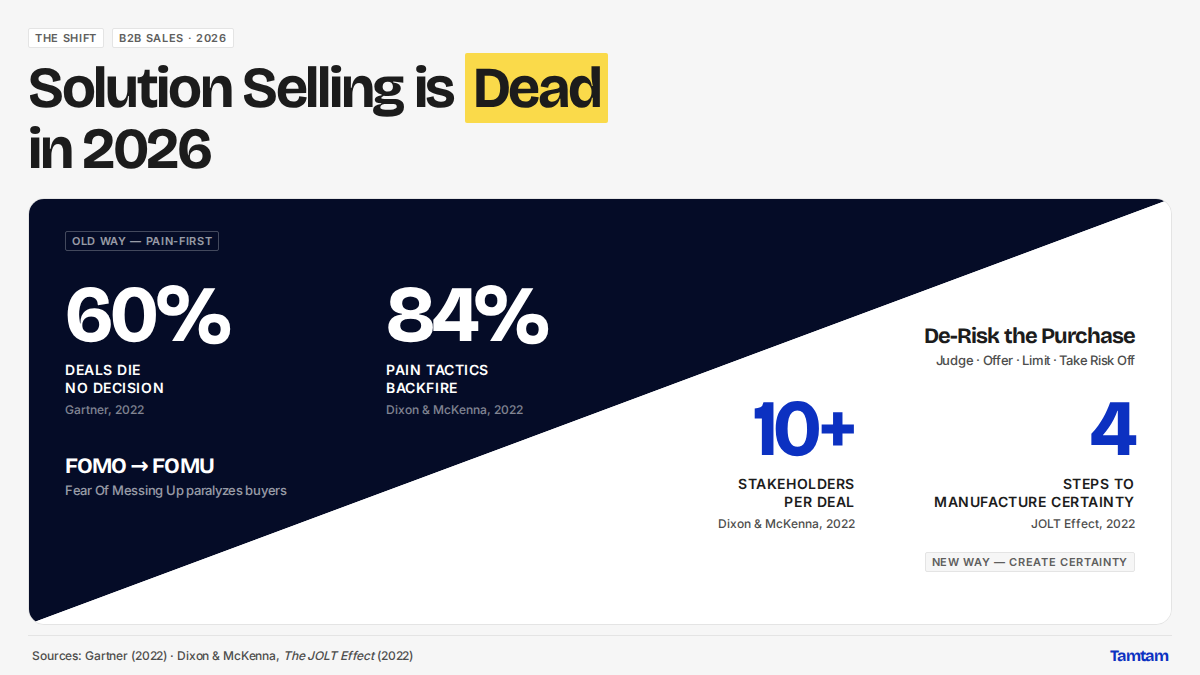
The traditional 'pain-first' sales playbook no longer works. Modern buyers are paralyzed by the Fear Of Messing Up (FOMU), not driven by FOMO, causing up to 60% of deals to end in 'no decision.' This happens because amplifying pain points increases their anxiety. The new winning strategy involves acting as a 'decision therapist' by creating certainty, curating options, and de-risking the purchase to guide anxious buyers to a confident close.
Let’s treat your pipeline like a crime scene for a minute.
For years, the cause of death for most deals was obvious: you got outmaneuvered by a competitor, the budget disappeared, or your champion left the company. But lately, the scene has changed. The victim: a perfectly qualified deal. The budget is there. The champion is still employed. Yet, the deal is dead. The official cause: "lost to no decision."
This isn't an isolated incident. It’s an epidemic. According to Gartner, a staggering 40% to 60% of all qualified B2B purchase attempts end in no decision at all. They just fizzle out. Your CRM is a graveyard of these ghost deals.
For decades, solution selling and the other old-school sales methodologies in every rep's playbook preached one gospel: find the pain, twist the knife, and create urgency through the Fear Of Missing Out (FOMO). "If you don't solve this problem now," the script goes, "your competitors will eat your lunch, your revenue will crater, and you’ll be living in a van down by the river."
The problem is, this playbook is now the murder weapon. Research from Matthew Dixon and Ted McKenna, authors of The JOLT Effect, found that when reps twist the knife on a customer's problems, it backfires 84% of the time and actually increases their indecision.
You’re trying to create urgency, but you’re actually creating anxiety. You’re trying to highlight the risk of inaction, but you’re just reminding them of the risk of any action. The game has changed, and the old rules are getting you killed.
So, what the hell happened?
The fundamental psychology of the B2B buyer has inverted. The primary driver is no longer FOMO. It’s FOMU: the Fear Of Messing Up.
In the past, the biggest risk was sticking with the status quo for too long and getting left behind. Today, in a world of information overload, economic uncertainty, and complex buying committees, the biggest perceived risk is making the wrong choice. Doing nothing feels safer than doing something that might blow up in your face.
This is rooted in a well-documented cognitive bias: the Omission-Commission Bias.
And in a volatile economy, that’s a career-limiting, fucking terrifying prospect.
This paralysis is supercharged by two other factors. First, information overload. Buyers have access to endless reviews, competitor websites, and AI-generated summaries. This should make them smarter, but as Hick's Law in psychology dictates, the more choices you have, the longer you take to decide. They're drowning in data, not enlightened by it.
Second, buying committees have ballooned. Getting a deal done today often requires sign-off from 10 or more stakeholders across finance, IT, legal, and operations. That’s ten different people who can say "no" and are terrified of being the one who said "yes" to a bad idea.
So when you show up with your old-school playbook and start poking at their pain, you're not a helpful guide. You're just another voice confirming that everything is on fire and any move they make could be the wrong one.
The best sellers have already adapted. They've stopped being pain diagnosticians and have become "decision therapists." They don't sell solutions; they sell certainty.
Let’s see how this plays out in the wild.
Average Andy finds a champion in the marketing department who loves his tool. He arms her with a deck and hopes for the best. He tries to create urgency by telling her their current process is costing them leads. A month later, she ghosts him. The deal stalled in the CFO’s office over budget concerns and got red-flagged by IT security. Andy never even spoke to them.
Certainty Claire, on the other hand, knows the champion is just the first step. She multi-threads from day one. She proactively builds a custom ROI model for the CFO, showing a phased rollout plan that minimizes upfront risk. She sends the Head of IT a pre-packaged security dossier, answering all their questions before they’re even asked. She doesn't just sell a tool; she shepherds the entire organization through a complex decision, making each stakeholder feel safe and smart. She wins the deal.
Vague Victor starts his calls with wide-open discovery questions like, "So, what keeps you up at night?" He hopes the prospect will diagnose their own pain. Then, he presents three different pricing tiers, hoping they'll pick one. The buyer, already overwhelmed, asks for more case studies to "review." The deal goes into a black hole of perpetual consideration.
Prescriptive Priya does her homework before the call. She has a strong hypothesis about the prospect's challenges based on their industry and recent company news. She opens with, "I saw you just launched a new enterprise product line. Typically, companies like yours struggle with X and Y when that happens. Is that on your radar?" She guides the conversation. At the end, instead of showing a menu, she makes a firm recommendation: "Based on your goals, Plan B is the only one that makes sense. Plans A and C won't work for you, and here's why." By limiting options and providing an expert opinion, she shoulders the cognitive load for the buyer, making it easy for them to say yes.
Priya isn't being pushy. She's being a leader. She’s creating certainty in a world of chaos.
I can already hear the grizzled sales veterans cracking their knuckles. "This is just soft-selling nonsense!" Let's tackle the two biggest objections head-on.
1. "Without pain, there's no urgency."
This isn't about ignoring pain. It's about changing its role. Pain is what gets them to the table. An insight, a challenge, or a problem is what breaks their attachment to the status quo. You still need to do that. Think of it like the Challenger Sale: you need to teach them something new about their business.
But once they agree a problem exists, your job flips. You must switch from being an agitator to a de-risker. Pain gets the meeting. Certainty gets the signature. Continuing to hammer on the pain after they're already engaged is like a doctor repeatedly telling you how sick you are after you've already agreed to the treatment. It's not helpful; it's just stressful.
2. "Limiting options is just high-pressure selling."
Wrong. It’s about being an expert, not a cashier.
Imagine going to a top surgeon for a complex procedure. You don't want them to hand you a 500-page medical textbook and say, "Have a look and let me know which surgical approach you'd prefer." You want them to look you in the eye and say, "I've done this a thousand times. This is the best course of action for you. Here is why."
Curating options is an act of empathy. You are using your expertise to save your buyer from the exhausting, paralyzing work of sifting through irrelevant information. You’re not withholding anything. You’re providing a professional recommendation. It’s the highest form of value you can offer an anxious, overworked buyer.
So how do you do this systematically? The JOLT framework, developed by Dixon and McKenna, is a brilliant, actionable model. It’s a four-step process for managing buyer anxiety and guiding them across the finish line.
1. Judge the Indecision First, you have to accurately diagnose FOMU. Listen for the tells. Buyers who are merely evaluating will ask about features and pricing. Buyers suffering from indecision will ask for more and more information, use waffle words ("this seems interesting," "we're thinking about it"), and delay committing to next steps. Your conversation intelligence software can even help you track these linguistic patterns at scale. Don't mistake consideration for paralysis.
2. Offer Your Recommendation Once you've identified indecision, you must step up and be prescriptive. Stop presenting yourself as a neutral vendor with a menu of options. Synthesize everything you've learned and make a clear, confident recommendation. Use phrases like:
3. Limit the Exploration Paralyzed buyers believe more information will lead to more clarity. It won't. It will only lead to more confusion. Your job is to gently put up the guardrails. Acknowledge their diligence, then re-focus them on the core decision. You can say something like, "We could spend another month exploring edge-case scenarios, but we’ve confirmed this solves your three core problems. Is there anything about those three that we haven't covered?" This helps them feel the cost of delay not as a vague future threat, but as a direct impediment to getting the value they need now.
4. Take Risk Off the Table This is the final, crucial step. You have to neutralize the career risk associated with the decision. This is where you get creative:
Look, manufacturing certainty isn't just another closing trick. It's the entire goddamn foundation of a modern sales motion. It starts before you even send the first email. You kill FOMU by showing up with a point of view, not a question mark. Instead of a generic "pain" hypothesis, you arrive with a clear, signal-based reason for the conversation that proves you’ve done the work. That single act of showing up prepared shifts the dynamic from interrogation to collaboration. It’s how you build a pipeline that actually closes, and it's the entire thesis behind how platforms like Tamtam identify opportunities.
Set up for you before our first call
Book a demo