June 8, 2026
The Challenger Sale methodology isn't dead, but its original playbook is outdated. The primary obstacle in modern B2B sales is no longer the status quo but rather buyer indecision, driven by a deep-seated Fear of Messing Up (FOMU). Reps often fail by misinterpreting "challenging" as being aggressive, instead of embodying the "Disagreeable Giver" mindset that prioritizes customer success over being liked. Winning today requires a new approach: combining commercial teaching with tactical empathy, de-risking the purchase for the buyer, and leveraging AI for data so reps can provide the uniquely human courage needed to close deals.
Let’s be honest. You’ve met this person. Maybe you’ve even been this person.
The Well-Researched Asshole.
They swagger into a meeting, physical or virtual, armed with a deck full of "shocking" industry stats and a graph that goes up and to the right. They’ve done their homework. They know your company’s revenue, your CEO’s favorite brand of coffee, and the glaring, obvious flaw in your entire go-to-market strategy.
And they can’t wait to tell you about it.
“You see,” they begin, with the smug confidence of someone who just watched a webinar, “your customer acquisition cost is 15% higher than the industry benchmark. You’re burning cash. If you don’t fix this, you’ll be obsolete in 18 months.”
The buyer, a VP of Ops who has been fighting internal political battles for a decade, just stares back. They don’t feel enlightened. They feel insulted. The rep didn’t build rapport. They didn’t earn the right to challenge. They just walked in, called the baby ugly, and expected a thank you.
The meeting ends politely. The follow-up email gets archived without a reply. The deal is dead.
This is the most common, most spectacular failure of the Challenger Sale, the most misunderstood of the modern sales methodologies. Reps read the book, get hyped up on "commercial teaching," and completely miss the point. They think "challenging" means being a contrarian, a know-it-all, a human-shaped Gartner report.
They’re wrong. The Challenger Sale isn't a license to be a pushy jerk. It's a psychological framework that requires two things most reps lack: professional courage and tactical empathy. It's about creating constructive tension, not just dropping data bombs and running. It’s the difference between a doctor telling you to lose weight and a doctor who helps you understand why and builds a plan with you.
One makes you defensive. The other makes you a partner.
The reason so many reps default to being either a Well-Researched Asshole or a spineless people-pleaser comes down to a fundamental psychological model. Organizational psychologist Adam Grant, in his book Give and Take, breaks people down into four types based on two axes: their tendency to give versus take, and their agreeableness versus disagreeableness.
This gives you four quadrants:
Disagreeable Givers are the people who will tell you the hard truth, not because they enjoy conflict, but because they genuinely have your best interests at heart. They prioritize your success over your temporary comfort, and over their own need for approval. They have, as one Google engineer famously described a colleague, "a bad user interface but a great operating system."
They’re the coach who makes you run one more lap because they know you can be better. They’re the friend who tells you to stop dating that person who is clearly bad for you. They’re willing to risk being disliked in the short term to deliver value in the long term.
Most sales training pushes reps to be Agreeable Givers. "Build rapport! Find common ground! Always be helping!" The Challenger model, when done right, is about cultivating the mindset of a Disagreeable Giver. It’s about having the courage to say, "I think your approach is wrong, and here's why. This might be uncomfortable to hear, but we need to talk about it."
That takes guts. It’s much easier to be liked. But being liked doesn’t close seven-figure deals. Being trusted does. And trust is often born from the courage to have a difficult conversation.
The original Challenger Sale book, published in 2011, was brilliant. Positioned as the heir to solution selling, it identified a new landscape where buyers were drowning in information and needed sellers to be sense-makers, not feature-reciters. The core premise was that the biggest competitor wasn't another vendor; it was the customer’s own status quo.
For a decade, that was largely true. Sales teams got very good at building a business case for change.
But the world has changed again. The problem is no longer getting people to want to change. The problem is getting them to actually make a decision.
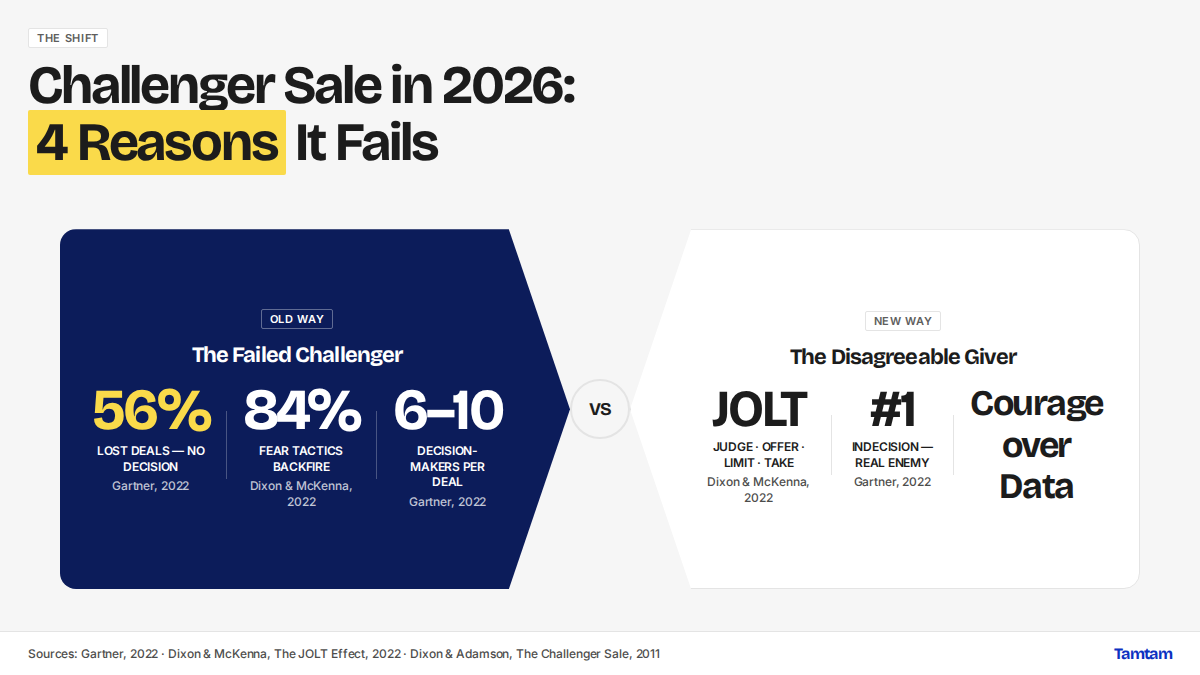
According to research from Gartner, the authors of the original book, a staggering 56% of deals that are lost to "no decision" aren't lost because the customer chose the status quo. They’re lost because the customer wanted to change but was paralyzed by indecision.
Welcome to the age of FOMU: the Fear Of Messing Up.
Buying committees are larger than ever. The average B2B deal now requires 6 to 10 decision-makers, each with their own veto power. The amount of information is overwhelming. The risk of choosing the wrong solution and damaging your career feels higher than ever. It's a recipe for analysis paralysis.
Here's the terrifying part: when you take the classic Challenger approach of "teaching, tailoring, and taking control" and apply it to a buyer who is already overwhelmed and indecisive, it backfires 84% of the time.
Why? Because dialing up the fear ("You're burning cash! You'll be obsolete!") on someone who is already terrified doesn't spur them to action. It pushes them into a defensive crouch. You’re not fighting their complacency anymore. You're fighting their anxiety.
So, what works? You have to evolve from a commercial teacher into a decision-making therapist.
In their follow-up book, The JOLT Effect, Matthew Dixon and Ted McKenna lay out a new framework designed specifically to combat indecision. It’s a four-part strategy to guide the customer through their own fear:
This isn’t about abandoning the Challenger mindset. It’s about aiming it at the right target. The challenge is no longer "Why change?" It's "How to decide?"
Let's talk about the elephant in the room: artificial intelligence.
For the Well-Researched Asshole, AI is a dream come true. You can now generate a perfectly tailored, data-rich point of view on any company in seconds. You can know everything there is to know before you ever speak to a human.
But this just makes the problem worse. If anyone can get the data, the data itself is no longer the advantage. It’s a commodity. Having a killer insight is table stakes. Your value is no longer in what you know. It's in how you deliver it.
Your real job, the one AI can't do, is to provide the human element: the courage, the political navigation, and the tactical empathy to make that data mean something.
This is where the work of former FBI hostage negotiator Chris Voss is so critical. Challenging a customer without what he calls "tactical empathy" just makes you sound arrogant. Before you can challenge, you must first earn the right by demonstrating that you understand their world, their fears, and their problems, maybe even better than they do.
Sales leader Jen Allen-Knuth calls this a "problem-first" approach. You don’t lead with your solution. You lead by articulating the buyer’s problem with so much clarity that they feel deeply understood. You say things like, "It seems like you're worried about how this new system will integrate with your legacy tech stack," or "I get the sense that getting the finance team's buy-in on this is going to be a major hurdle."
Voss calls these "accusation audits." You voice the unspoken fears and objections before the buyer does. This signals that you’re not afraid of the hard parts. It shows you’re an expert who has seen this movie before. Only then, once you’ve established that baseline of trust and understanding, can you effectively challenge their assumptions.
The modern Challenger rep doesn’t spend hours digging through 10-K reports and network profiles. They let technology surface the critical signals. They use their time to practice their delivery, to map the political landscape of the buying committee, and to strategize how to make their champion look like a hero. The AI provides the "what." You provide the "so what" and, most importantly, the guts to say it.
The real challenge today isn't finding a needle in a haystack. It's knowing what to do with the needle once you've found it. And that requires courage, a commodity that can’t be automated. Your job is to be the catalyst for courage within your buyer’s organization.
The best reps of the next decade will be masters of this synthesis. They will operate as Disagreeable Givers, armed with AI-surfaced insights but deployed with the tactical empathy of a therapist. Their primary focus will shift from blanketing the market with activity to surgically applying their very human skills to a small, hyper-relevant set of opportunities where a decision is waiting to be made. That focus, knowing precisely who to challenge and when, is the ultimate unfair advantage. It's the philosophy that platforms like Tamtam are built on: let the machines find the signal, so you can bring the damn courage.
Set up for you before our first call
Book a demo