October 27, 2026
Your massive B2B database is a lie, a graveyard of dead numbers that burns millions in payroll for zero return. The problem isn't your team's hustle; it's an outdated procurement mindset that prioritizes database size over data quality. This guide exposes the true cost of cheap data and shows why smart RevOps leaders are slashing their contact lists to double their pipeline. The future of outbound sales isn't a bigger list, it's a better one.
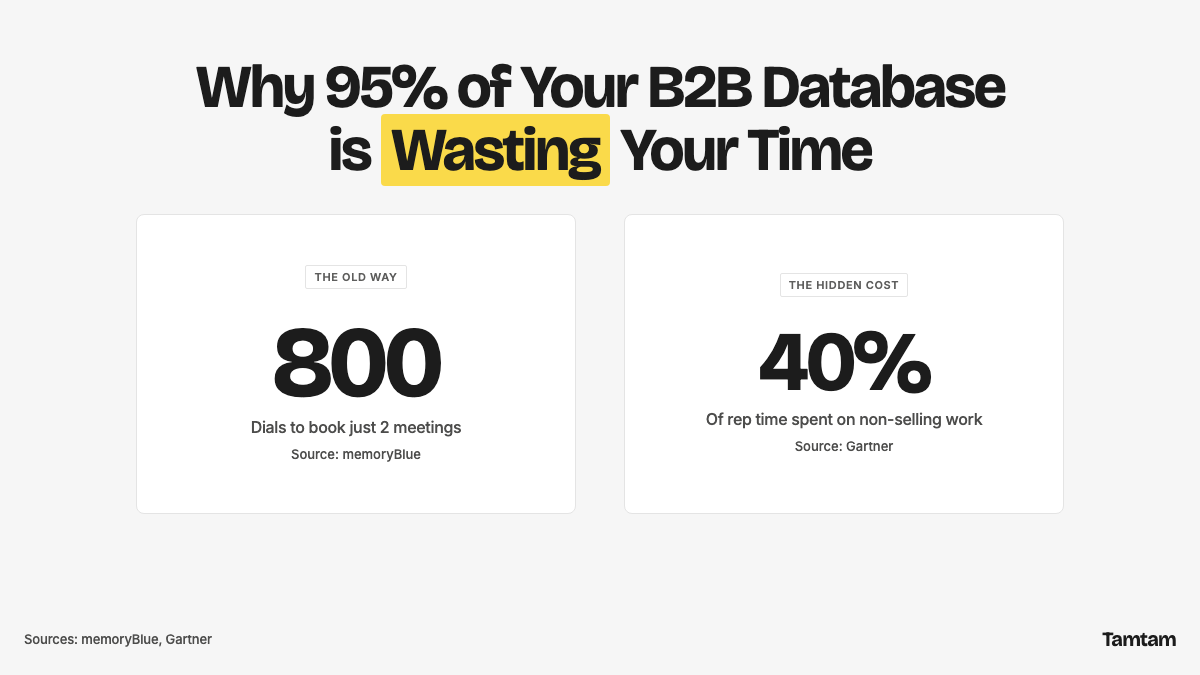
Let’s start with a number that should give every sales leader a panic attack. To book just two meetings, the average sales rep has to make 800 dials.
Read that again. Eight hundred.
That’s not a typo. That’s the soul-crushing reality of modern outbound, according to research from memoryBlue. For years, we’ve been told this is just the cost of doing business. The solution? More reps, more dials, more activity. Just keep feeding the machine.
But what if the machine is fundamentally broken?
This isn’t a skill problem. It’s not a script problem. It's not even a "your reps aren't hustling enough" problem. It’s a data problem. You're sending your highly-paid, highly-motivated sales team into battle armed with a map where 95% of the roads lead to a dead end.
They’re dialing switchboards. They’re leaving voicemails for people who left the company six months ago. They’re getting stonewalled by gatekeepers because they don’t have the one thing that cuts through the noise: a verified mobile number.
The status quo is mathematically insane. We've accepted a system where the vast majority of our team's effort is guaranteed to produce zero results. It’s time to call this what it is: a colossal waste of time, money, and human potential.
Your CRM says you have a Total Addressable Market (TAM) of 500,000 contacts. Your VP of Sales loves to put this on a slide for the board. It looks impressive. It feels like infinite potential.
It’s also a complete fantasy.
A massive list of unverified, low-quality contacts isn’t a TAM. It's a security blanket. It gives you the illusion of opportunity, which justifies the very behaviors that kill your team’s productivity. Because the list is "huge," you design 14-touch cadences that have reps calling the same dead number every other day for a month.
Here’s a hard truth from cold-calling data: 98% of all successful cold call conversations happen by the fifth dial attempt.
Let that sink in. If you haven’t connected with someone by the fifth try, the odds of you ever connecting with them plummet to almost zero. So that 14-touch cadence you’re so proud of? For the last nine touches, you’re not being persistent. You’re just proving you have a bad phone number.
A bloated database doesn't create pipeline. It creates busywork. It encourages reps to churn through dead leads instead of strategically working high-value accounts. The size of the list becomes the metric, not the quality of the conversations. You’re optimizing for activity, not results, because the underlying data is so poor that activity is the only thing you can reliably generate.
Your real TAM isn't the number of contacts in your database. It's the number of people you can actually reach. And for most teams, that number is terrifyingly smaller than they think.
So if everyone knows these giant databases are filled with junk, why do we keep buying them?
Because in most companies, the person buying the data isn’t the person responsible for the results. The decision is owned by the Procurement department, and Procurement operates on a simple, spreadsheet-friendly logic: get the lowest possible cost-per-record.
They see two vendors. Vendor A offers 1 million contacts for $50,000. That’s 5 cents a record. Vendor B offers 100,000 contacts with verified mobile numbers for the same $50,000. That’s 50 cents a record. To Procurement, it’s a no-brainer. Vendor A is 10x cheaper. They just saved the company a fortune.
Except they didn’t. They just saddled the sales team with a mountain of garbage that will cost the company millions in wasted payroll.
This decision must be owned by Revenue Operations (RevOps). RevOps leaders don’t think in cost-per-record. They think in Pipeline ROI and Total Cost of Ownership. They understand that paying 10x more for a list that is 20x more effective is the biggest bargain in the entire tech stack.
Here’s the difference in mindset:
| Metric | Procurement Mindset | RevOps Mindset |
|---|---|---|
| Primary Goal | Minimize upfront software cost | Maximize pipeline and revenue |
| Key Metric | Cost-per-Record | Pipeline ROI / Total Cost of Ownership |
| View of Data | A commodity to be acquired cheaply | A strategic asset that drives efficiency |
| Success Looks Like | A signed contract under budget | A measurable lift in meetings and pipeline |
| Question Asked | "How can we get more records for less?" | "How can we generate more conversations?" |
Until the person responsible for revenue is also the person responsible for the data that fuels it, companies will remain stuck in this procurement trap, patting themselves on the back for saving a few thousand on data while burning millions on payroll.
This flawed data strategy does more than just hurt your quarterly numbers. It actively sabotages the careers of your junior sales talent and makes it impossible to execute modern sales strategies.
First, you create the "glorified button-clicker." You hire a sharp, ambitious SDR, sit them in front of a parallel dialer hooked up to your garbage database, and tell them to hit a target of 200 dials a day. For the next two years, their primary job is to listen to the dial tone, navigate phone trees, and get shut down by receptionists.
They never learn the real craft of sales. They don’t learn how to do discovery. They don’t get enough at-bats in real conversations to practice navigating objections or using frameworks like SPIN selling. As one user on a popular social network forum put it, they just become "really good at leaving voicemails and getting hung up on." You're not building your next generation of Account Executives. You're burning them out on an assembly line.
Second, you render your expensive sales training completely useless. You bring in consultants to teach sophisticated plays. Your reps learn Armand Farrokh’s brilliant cold call opener: "Hey John, this is Mark. Can I tell you why I'm calling, and then you can tell me if it makes sense to keep talking?"
It’s a fantastic line. It’s disarming, respectful, and effective. But it’s designed for a decision-maker, not a switchboard operator in a call center halfway around the world. All the advanced tactics for tonality, pattern interruption, and objection handling are wasted if your reps can’t even get the target person on the phone.
You can't run an enterprise playbook on a small-business contact list. You need direct access. And direct access means one thing: verified mobile numbers. Without them, you’re just paying your reps to practice their pitch on the one person in the company whose job is to make sure they never get to use it.
The solution to this mess is simple, but it feels terrifyingly counterintuitive. You have to be willing to shrink.
Imagine a CRO at a $150 million tech company. The board is breathing down his neck about pipeline growth. The default answer is always "hire more SDRs, buy more data." But he does something different. He audits the entire outbound process and discovers what we’ve been talking about: his team is spending the vast majority of its time dialing dead ends.
So he makes a bold call. He cancels his contract with the mega-database vendor. He takes his list of 1 million contacts and slashes it by 80%, down to the 200,000 accounts that truly fit their Ideal Customer Profile. He then reinvests the savings into a premium data provider focused exclusively on providing verified mobile numbers for that smaller, more focused list.
In the next board meeting, he announces that the team’s total dial volume is going to go down. You can imagine the panic. "Fewer dials? Are you insane? We need more activity!"
But he holds his ground. He explains that they are trading useless activity for productive conversations.
One quarter later, he comes back with the results. Dials were down 40%. But conversations were up 100%. The number of qualified meetings booked was up 75%. And the total value of the outbound pipeline had increased by 60%.
He didn't need more reps or a bigger database. He needed a better one. He proved that the path to growth isn't about doing more things; it's about doing the right things. And the right thing is ensuring that when a rep picks up the phone, there’s a real person on the other end of the line.
At this point, two big objections are probably ringing in your head, likely in the voice of your CFO: "This premium data is too expensive," and "If we shrink the list, our TAM isn't big enough."
Let’s dismantle these one by one, using the language your CFO understands: money.
The "it's too expensive" argument falls apart when you calculate the Total Cost of Ownership (TCO) of your cheap data. It’s not about the line item on the invoice from your data vendor; it's about the massive, hidden cost in your payroll.
Let’s do some back-of-the-napkin math. Say you have a team of 20 SDRs. Their fully-loaded cost (salary, benefits, tools) is around $100,000 each per year. That's a $2 million annual payroll. Conservative estimates from Gartner and others show that reps spend at least 40% of their time on non-revenue-generating activities, with a huge chunk of that being navigating bad data, researching contacts, and dialing wrong numbers.
40% of your $2 million payroll is $800,000.
You are spending almost a million dollars a year to pay highly-skilled humans to do a computer’s job badly. You are burning $800,000 for your team to manually verify a database that you bought specifically because it was "cheap." Suddenly, paying an extra $50,000 or $100,000 for clean, verified data doesn't seem so expensive, does it? It’s the highest-ROI investment you can possibly make.
As for the "TAM isn't big enough" argument, it’s a red herring. No sales team in history has ever successfully sold to their entire TAM. Your goal isn't to contact everyone. Your goal is to create pipeline. Focusing your team on a smaller, higher-quality list of contacts they can actually reach will generate more revenue, faster, than letting them wander aimlessly through a desert of 1 million unverified records.
A verified number gets you in the door. That's table stakes. But the real multiplier is knowing why to call today. It's about finding the handful of people in that smaller, better list who are actively signaling they have a problem you can solve. This shift from a volume game to a signal-driven strategy game is the only sustainable way to build pipeline. It’s the entire reason platforms like Tamtam exist: to find those signals so your reps can stop prospecting and start selling.
Set up for you before our first call
Book a demo