June 5, 2026
Your MEDDPICC process is likely broken because your reps fear an empty pipeline, leading to a "green checkmark culture" of self-deception. Reps mistake buyer politeness for commitment, justifying deals that are doomed to fail, a trend confirmed by data showing overly positive deals are more likely to be lost. The solution isn't a new framework but a mindset shift: use MEDDPICC to aggressively disqualify and hunt for the "No," transforming it from a justification tool into a weapon for verification.
Let's get one thing straight. MEDDPICC doesn't fail. People fail.
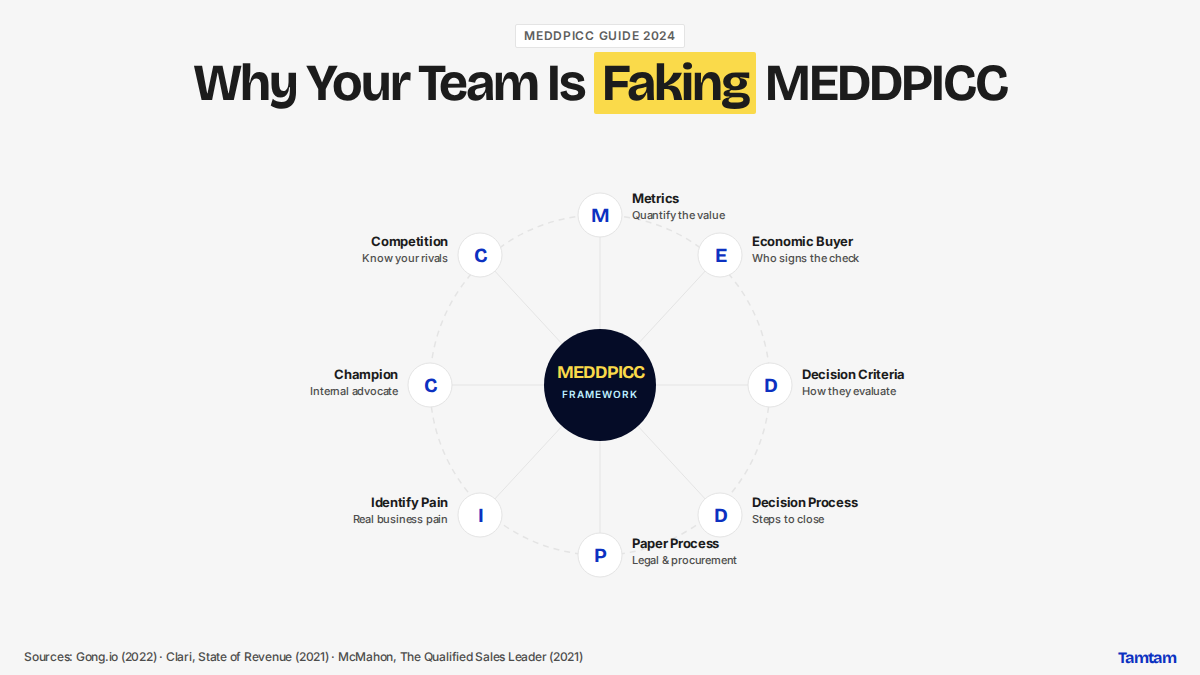
The framework itself is brilliant. It’s a battle-tested GPS for navigating complex enterprise deals, and one of the most demanding B2B sales methodologies ever built. Metrics, Economic Buyer, Decision Criteria, Decision Process, Paper Process, Identify Pain, Champion, and Competition. It’s the MEDDIC framework on steroids, a logical and exhaustive list of everything you need to know to close a deal.
So why do so many teams with "rigorous" MEDDPICC processes still miss their forecasts by a country mile?
Because they use it backwards.
They treat it like a checklist to fill out after a call, a way to retroactively justify why a deal should be in the pipeline. They aren't using it as a weapon to uncover the brutal, uncomfortable truth of the deal. Instead, it becomes a scorecard for "happy ears."
The rep has a nice chat with a mid-level manager who seems enthusiastic. Check. The manager says the budget "shouldn't be a problem." Check. They agree to "circle back" in two weeks. Check. Suddenly, you have seven green checkmarks in your CRM and a deal that feels solid.
But it’s a mirage. Your CRM becomes a monument to your own bullshit.
The pressure for 3x or 4x pipeline coverage forces this behavior. An empty pipeline is terrifying, both for the rep who fears for their job and the manager who fears for their forecast. So, we collectively agree to believe in fantasies. We keep unqualified deals on life support because the alternative, an honest but thin pipeline, is too scary to face.
This guide isn't about the letters in MEDDPICC. It's about the two mindsets that determine whether it’s a tool for truth or a machine for self-deception.
This is the default setting for most sales teams. It’s the path of least resistance, paved with good intentions and hopium. The primary goal here isn’t to verify a deal's viability but to find enough evidence to justify its existence in the forecast.
Who it's "best" for: Honestly? It's best for sales leaders who prioritize the appearance of a full pipeline over forecast accuracy. It’s for managers who would rather avoid uncomfortable conversations and for reps who are terrified of prospecting. It’s a culture of comfort over results.
Strengths:
Weaknesses:
A stunning piece of research from Gong proves this point. They analyzed millions of sales calls and found that lost deals actually had 12.8% higher positive sentiment than won deals. The customer is friendly, agreeable, and never pushes back. It’s a pleasant, frictionless conversation. And it’s completely fake. Your rep mistakes politeness for a buying signal.
Verdict: The "Green Checkmark" culture is a slow-acting poison that trades short-term comfort for long-term failure and erodes your credibility as a leader.
This approach reframes MEDDPICC entirely. It’s not a reporting tool; it's an interrogation tool. The goal isn't to get to "Yes." The goal is to get to the truth, as quickly and efficiently as possible. And very often, the fastest path to the truth is by actively seeking "No."
Who it's best for: Sales leaders who are judged on predictable revenue, not pipeline volume. It's for top-performing AEs who hate wasting their time on deals that won't close and would rather spend their energy on winning. It’s for teams that value honesty and results over appearances.
Strengths:
Weaknesses:
This is where tactics from hostage negotiation, like those from Chris Voss, become sales superpowers. Voss teaches the concept of "no-oriented questions" which are designed to make the other party feel safe by giving them an easy out. Instead of "Is this a good time to talk?" you ask, "Is now a bad time?" Instead of "Are you interested in solving this problem?" you ask, "Have you given up on solving this problem?"
A "No" answer to that last question is actually a commitment. It tells you they're still in the game. A "Yes" disqualifies them instantly, saving you weeks of follow-up. You're using MEDDPICC to find the landmines, not to pretend they don't exist. You have to multi-thread to do this properly; Gong's data shows the average enterprise deal now involves about 17 stakeholders. You can't get to all of them by being polite.
Verdict: The "Ruthless Truth-Seeker" mindset is hard, uncomfortable, and requires courage. It's also the only way to build a predictable revenue machine.
| Criteria | "Green Checkmark" Culture | "Ruthless Truth-Seeker" |
|---|---|---|
| Primary Goal | Justify the pipeline | Verify the deal |
| Rep Behavior | Seeks agreement ("happy ears") | Probes for objections |
| Manager's Role | Pipeline administrator | Deal inspector and coach |
| Forecast Accuracy | Low / Volatile | High / Predictable |
| Pipeline Health | Inflated, full of "hopium" | Lean, but highly qualified |
| Average Deal Size | Small, low-value pilots | Enterprise-level ACV |
| Emotional State | False comfort, then panic | Productive discomfort, then confidence |
The choice between these two cultures boils down to a single, uncomfortable question: What are you truly optimizing for?
Be honest with yourself.
If you are optimizing for comfort and the appearance of activity, then stick with the Green Checkmark culture. Your CRM dashboard will look amazing. Your pipeline coverage numbers will be easy to report up the chain. Your weekly forecast calls will be smooth and painless, right up until the last two weeks of the quarter when reality detonates in your face.
If you are optimizing for revenue and predictability, you have to embrace the Truth-Seeker mindset. It’s not optional. Your pipeline meetings will be tense interrogations. You’ll have tough conversations with your reps about their prospecting efforts. You will have to report a smaller, but honest, pipeline to your board. But your forecast will be real. Your team will respect you. And you will hit your number.
There is no third option. You are either running a team that prioritizes feelings or a team that prioritizes facts.
The chaos from missed forecasts isn't solved by a stricter process. It's solved by a courageous decision to stop lying to yourselves. The root cause of all bad MEDDPICC hygiene is fear of an empty pipeline, and the only cure is a non-negotiable culture of prospecting. Coach your reps to disqualify with confidence. Teach them to look past CRM checkmarks for objective signals of real buying intent. The goal isn't a full pipeline; it's a real one, built on leads with actual buying triggers, which is precisely what Tamtam is designed to find.
Set up for you before our first call
Book a demo