June 2, 2026
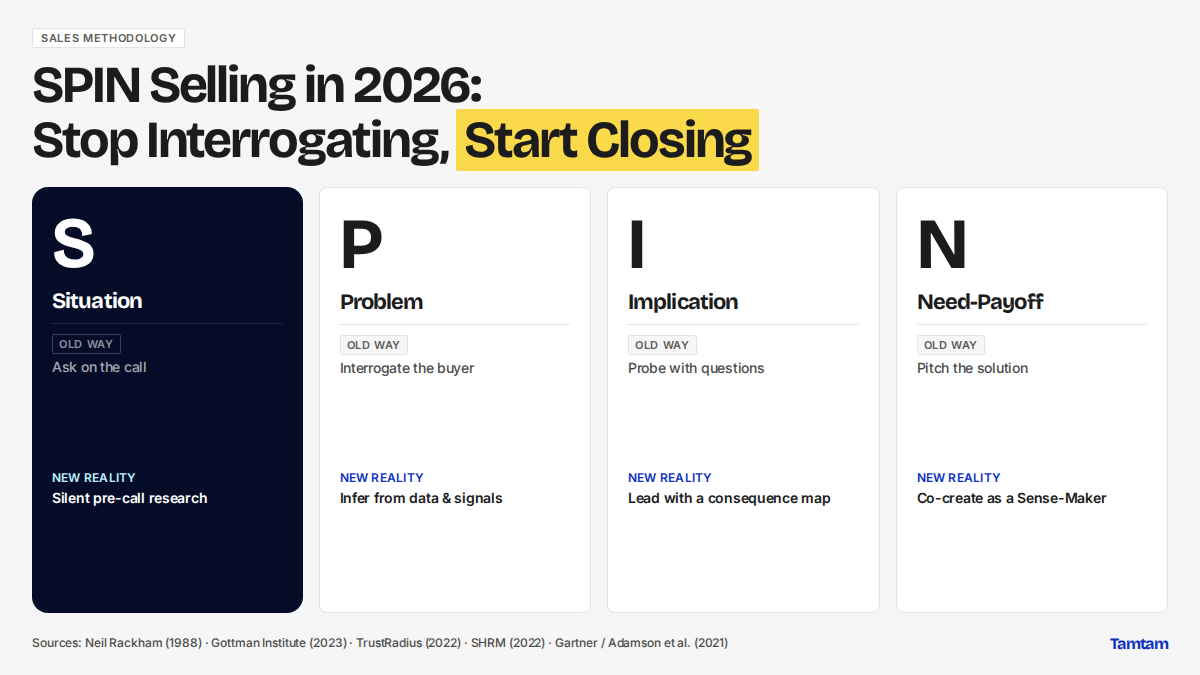
Stop asking basic Situation and Problem questions on calls, as it signals a lack of research and alienates modern buyers. The modern approach to SPIN selling is to use it as a pre-call research framework, not a script. By silently mapping the buyer's situation and likely problems beforehand, you can open the conversation with a powerful Implication or Need-Payoff hypothesis. This researched point of view establishes you as a peer, and even if your initial assertion is wrong, it prompts the buyer to share the real issues, moving the conversation forward.
Let’s be honest. For decades, SPIN selling has been the bible. Situation, Problem, Implication, Need-Payoff. It’s one of those classic sales methodologies so foundational it’s practically tattooed on the soul of every sales leader over 40.
And in 1988, it was genius.
But in 2026, using it like a live script is sales suicide.
Your buyer today is not the buyer from 1988. They aren't waiting by their desk phone for a charming rep to educate them. They’re drowning in information. By the time they talk to you, they've already read G2 reviews, watched three of your competitor's webinars, and lurked on your pricing page. According to a 2022 TrustRadius report, the majority of B2B buyers are now millennials or Gen Z, people who grew up with the entire world's knowledge in their pocket.
So when you hop on a call and ask a basic Situation question like, "So, tell me about your tech stack..." you're not opening a conversation. You're triggering their bullshit detector.
You’re signaling one thing: "I couldn't be bothered to do five minutes of research on you."
This isn’t just a bad first impression. It triggers a powerful psychological reaction. Relationship psychologist John Gottman identified four behaviors that predict the end of a relationship with terrifying accuracy. The number one predictor? Contempt. It’s the feeling that a person is beneath consideration, worthless, or deserving of scorn.
When you ask a question a quick search on their network profile could have answered, you are generating contempt. You're not a peer. You're a pest. A time-waster. And the deal is dead before you ever get to "P".
The principles behind SPIN aren't the problem. The linear, question-based application of it is. To make it work today, you have to invert the entire model. You have to use it as a silent, pre-call framework to build a rock-solid hypothesis, not as a script to interrogate your buyer.
Here’s how.
The single biggest mistake reps make is using precious call time to uncover basic facts. You have to stop. Every second you spend asking a Situation or Problem question that you could have answered yourself is a second you're digging your own grave.
Why this matters: Respect. Buyers expect you to know the basics. Your company, their industry, recent news, their role. When you do this research silently before the call, you’re communicating that you value their time more than your own. You’re earning the right to their attention.
What to do: Your pre-call research needs to become a non-negotiable ritual. Your goal is to build a "dossier" that answers the S and P questions without ever having to ask them.
A story of disaster: An AE we know, let's call her Jane, landed a call with "Susan," a Head of RevOps at a hot tech company. Jane opened with a classic: "So, Susan, can you walk me through your current forecasting process?"
Silence.
Then Susan replied, her voice flat. "I wrote a 2,000-word article about our exact forecasting process on a professional social network three days ago. It has over 500 likes. Clearly, you haven't seen it."
The call lasted another five minutes. Susan gave one-word answers. The deal wasn't just lost; it was vaporized in a cloud of pure contempt. Jane didn't lose to a competitor. She lost to a search bar.
Common Mistake to Avoid: Opening a call with a generic, open-ended question like "So what keeps you up at night?" or "What are your top priorities for Q3?" This screams, "I have nothing for you, so please do my job for me." It’s the fastest way to get ghosted.
Once you've done your silent S & P homework, you have a pile of facts. Now, you have to connect them to what actually matters: money, risk, and opportunity. This is where you map the Problem to a painful business Implication and then hypothesize the Need-Payoff.
Why this matters: This is how you transform from a product-pusher into a business peer. You’re not talking about features; you’re talking about business outcomes. This map is your entry ticket to a strategic conversation.
What to do: Take your hypothesized Problem and ask yourself two questions:
A problem without a number is just an opinion. You need to attach a metric to the pain. It could be cost, revenue, time, or risk.
Example: You’re selling a logistics platform to the CFO of a manufacturing firm.
Now you don't have a sales pitch. You have a business case.
Common Mistake to Avoid: Finding a problem but failing to quantify it. Saying "your employee churn seems high" is weak. Saying "I saw on a social network that you're trying to fill 50 open roles, and based on a standard cost-per-hire of $4,700 according to SHRM, that’s a $235k problem before we even talk about lost productivity" is strong.
Your research is done. Your Consequence Map is built. Now it’s time for the call.
Do not, under any circumstances, open the call by asking for information. Open it by offering an insight. You must lead with a strong, researched assertion based on your map.
Why this matters: This is the moment you reframe the entire power dynamic. You’re not a vendor begging for time; you're an expert offering a valuable perspective. It takes guts, but it's the only way to command respect from a busy executive.
What to do: Frame your opening as a hypothesis. The goal isn't to be 100% right. The goal is to show you've done the work and force a reaction.
Sales leader Brian LaManna has a brilliant framework for this:
This is night-and-day different from "So, what are your priorities?" You're showing up with a point of view. You're giving them something to react to.
Common Mistake to Avoid: Hedging. Don't water down your assertion with weak language like "I could be wrong, but..." or "This might be a silly idea..." or "I was just thinking..." Stand behind your research. Deliver it with conviction. If you don't believe in your own insight, why the hell should they?
Here's the part that terrifies most reps: "What if my hypothesis is wrong?"
Good. I hope it is.
Because being wrong is often more valuable than being right. When a buyer corrects you, they drop their guard and tell you the actual problem. They feel compelled to set the record straight, and in doing so, they hand you the keys to the kingdom.
Why this matters: This removes the pressure of having to be a perfect, psychic mind-reader. Your job isn't to be omniscient. Your job is to be a well-researched conversation starter. Adopt the mindset of "strong opinions, loosely held."
What to do: When the buyer says, "No, you're off base..." or "Actually, that's not it at all..." don't panic. Don't get defensive. Don't apologize.
This is your moment. Shut up and listen.
Then, use a simple technique from former FBI negotiator Chris Voss: mirroring. Simply repeat the last one to three words your counterpart said, with a questioning intonation.
Example of it working perfectly: Let's go back to Brian LaManna's CRO hypothesis.
The CRO replies, "No, our pipeline for the new product is actually fine. My biggest nightmare is our customer churn rate. It's through the roof."
A weak rep would panic. But a smart rep pivots.
You: "Your churn rate?"
CRO: "Yeah, it's a disaster. We're losing customers faster than we can sign them. My CEO is breathing down my neck, and the board is asking questions. We think it's a problem with our onboarding process, but we can't prove it..."
Boom. You just lost the hypothesis but won the deal. The CRO just spent the next 10 minutes outlining his most urgent, expensive business pain. You got to the real "Problem" and "Implication" without a single interrogation question.
Common Mistake to Avoid: Getting defensive when your assertion is shot down. Don't say, "Well, my research suggested..." No one cares. The buyer just gave you a gift. Accept it gracefully. Acknowledge and label their emotion: "It sounds like that's incredibly frustrating." Then you can dig in.
Once you've used your hypothesis to uncover the real problem, your job changes again. You are no longer a seller. You are a guide.
Buyers are overwhelmed. Gartner research found that what buyers value most aren't reps who just provide more information, but those who help them make sense of it all. They call these reps "Sense-Makers." These sellers dramatically outperform everyone else because they help customers filter the noise, learn something new, and navigate the complexity of a decision.
Why this matters: Your hard-won insight from the pivot has now earned you the credibility to guide the conversation. You're not just another vendor; you're a trusted advisor who can bring clarity.
What to do: When the CRO reveals his churn problem, don't immediately jump into a pitch about your churn-reduction software. That destroys all the rapport you just built.
Instead, stay in the Sense-Maker role. Help them structure their thinking.
You: "Okay, that makes sense. Generally, our customers who've faced a similar churn issue tackle it in one of three ways: they overhaul their customer onboarding, they invest in a dedicated customer success platform, or they restructure their support team around key accounts. Given your current team structure, which of those feels most realistic to explore first?"
You're now co-creating the solution. You're mapping their problem to a world of possibilities and helping them choose the right path, a path that will, of course, eventually lead to your product.
Common Mistake to Avoid: The second you hear a pain point that fits your product, you immediately start feature-dumping. "Oh, churn! Well, our platform has a predictive analytics engine and automated playbooks and..." Stop. You're snatching defeat from the jaws of victory. Stay in the problem. Guide the conversation. Earn the right to present your solution later.
Look, the shift from interrogator to Sense-Maker is the single biggest leap you can make. But let's be real, building a deep consequence map for every account in your territory is a brutal, time-consuming grind. The real bottleneck isn't your ability to have a smart conversation; it's the hours of manual research required to earn that conversation in the first place. That’s why the next frontier isn’t just about better selling techniques, but about having a system that identifies the underlying triggers and connects the dots for you, so your team can walk into every call armed with a killer hypothesis. Platforms like Tamtam are built on this exact principle: automating the painstaking research to surface the handful of accounts that are actually ready for a strategic conversation right now.
Set up for you before our first call
Book a demo