June 9, 2026
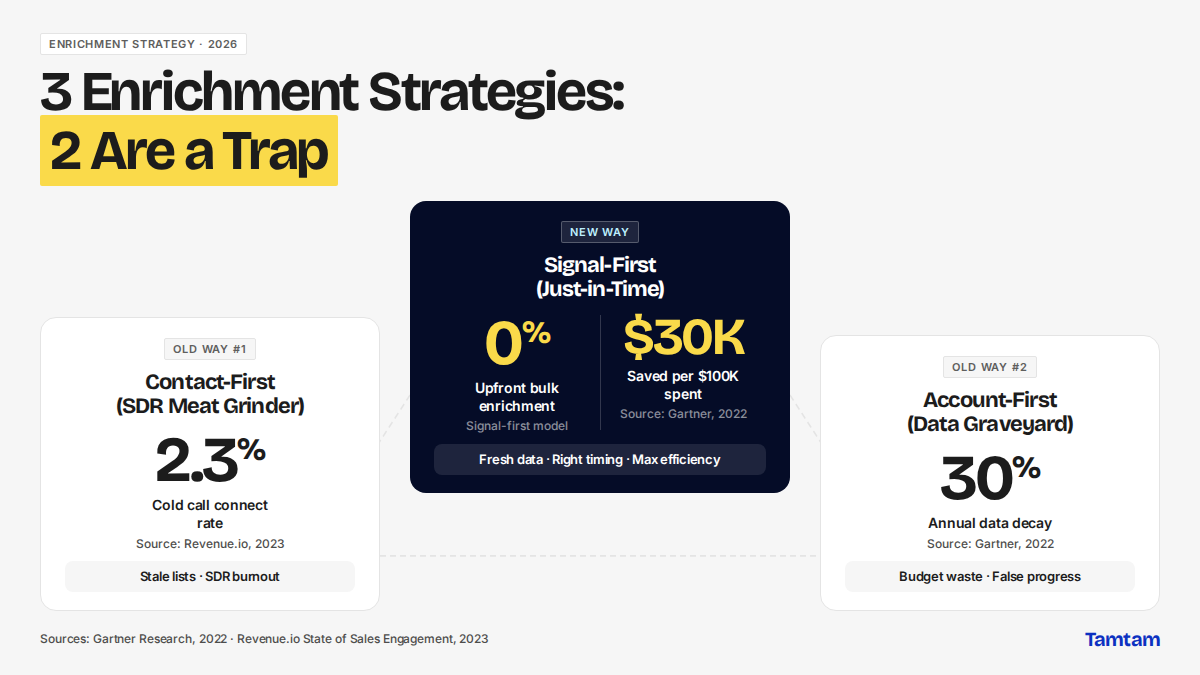
Stop enriching your entire CRM. The debate between 'contact-first' and 'account-first' enrichment is a false choice that builds a data graveyard and burns out your sales team. Both strategies rely on static data that decays at a rate of 30% annually, wasting your budget. The only effective modern approach is 'signal-first' enrichment, where you identify accounts showing active buying intent and then enrich key contacts at that precise moment, prioritizing timing over database size.
Look, the way we've been taught to think about data enrichment is fundamentally broken. We're told to pick a side: do you build your house from the bottom up (contacts first) or from the top down (accounts first)?
It’s a neat little debate. It's also a complete and total distraction.
Both sides of the argument share the same fatal flaw: they are static strategies in a dynamic world. Buyers now do most of their research in private, behind closed doors. By the time they pop up on your radar, your perfectly enriched, six-month-old contact list is already rotting.
According to Gartner, B2B data decays at a rate of 30% per year. Think about that. For every $100,000 you spend on a beautiful, static database, you might as well light $30,000 on fire. This isn't just inefficient; it's a form of "revenue theater." It's a way for sales leaders to feel in control with tidy CRM dashboards, while their SDRs are burning out dialing disconnected numbers and emailing people who left their jobs six months ago.
Let's break down the three real options you have. Two of them are traps. One of them is the future.
This is the old-school, brute-force method. You buy or build massive lists of individual contacts based on simple firmographics. "Give me every VP of Marketing in SaaS with 500-5000 employees." Then you dump them into a sequencer and let the outbound machine go brrr.
Honestly? No one who wants to build a sustainable business. This model is a trap, built for teams that prioritize activity metrics over actual pipeline and view their SDRs as disposable assets.
The contact-first approach is a relic from a bygone era. It treats sales as a numbers game of pure volume, ignoring the fact that modern buyers demand relevance.
This approach feels more strategic, which makes it a more dangerous trap. You start by identifying a specific list of target accounts. Your Ideal Customer Profile (ICP) is tight. You've aligned with marketing. Then, you go out and bulk-enrich every potential contact at those 500 companies. The CRM looks clean. The plan feels solid.
Enterprise teams with a very small, clearly defined, and finite list of high-value accounts. It's an improvement over the contact-first chaos, but it's still deeply flawed for most modern sales motions.
The account-first approach is revenue theater at its finest. It looks and feels strategic, but it wastes a fortune on data that rots on the vine because it fundamentally ignores the most important variable: timing.
This approach flips the entire model on its head. You stop hoarding data. You don't bulk-enrich anything upfront. Instead, you monitor your entire addressable market for real-time buying signals.
What's a signal? It's any event that suggests an account might be ready to buy. A key executive just started a new job. The company posted five open roles that mention a problem you solve. They just acquired a smaller company. Their CTO spoke on a podcast about a major new initiative.
Only when you detect a high-intent signal at an account do you trigger a just-in-time enrichment for the most relevant contacts on the buying committee.
Modern revenue teams that care about efficiency, pipeline velocity, and SDR morale more than they care about vanity metrics like "CRM completeness."
Signal-first isn't just a different strategy; it's a different philosophy. It acknowledges that timing is everything and builds the entire GTM motion around that truth.
| Approach | Core Focus | Data Freshness | Typical Cost | SDR Experience | Pipeline Impact |
|---|---|---|---|---|---|
| Contact-First | List Size | Extremely Low | High & Wasteful | Robot Dialer / Burnout | Random Acts of Pipeline |
| Account-First | Account Coverage | Low | Very High & Wasteful | Researcher / Frustration | Lumpy & Unpredictable |
| Signal-First | Buyer Intent | Extremely High | Low & Efficient | Consultant / Empowered | Focused & Predictable |
Forget "contact vs. account." That's the wrong question. The only question you should be asking is: When do we enrich?
Your answer to that question puts you into one of two camps.
You Enrich Quarterly (The Static Model): This is the world of contact-first and account-first. You're essentially building a museum. You prioritize having a tidy, complete-looking CRM that you can show off in board meetings. Choose this path if you're comfortable writing off up to 30% of your data budget each year to data decay. Also, make sure you budget for high SDR turnover, because you're going to need it.
You Enrich Just-in-Time (The Dynamic Model): This is the signal-first world. You prioritize speed, relevance, and efficiency. You choose to connect with buyers in the specific window of time they are actually listening. This requires building a process that values reacting to market signals over executing a static plan. Your cost-per-opportunity will plummet, your best reps will build real pipeline, and they'll stick around to see it convert.
The most expensive data you own is the data you never use. So stop pouring money into building a perfect, static database of contacts and accounts. The game has changed. The winning move is to build a lean, agile system that monitors for buyer intent and gives your reps hyper-fresh, hyper-relevant data at the exact moment it matters. To do that, you need to stop enriching your CRM and start enriching your conversations. Tools like Tamtam are built for this exact philosophy, shifting the focus from list-building to opportunity-finding by researching your entire market for the buying triggers that precede a deal, then serving up the right contacts at the right time.
Set up for you before our first call
Book a demo