June 3, 2026
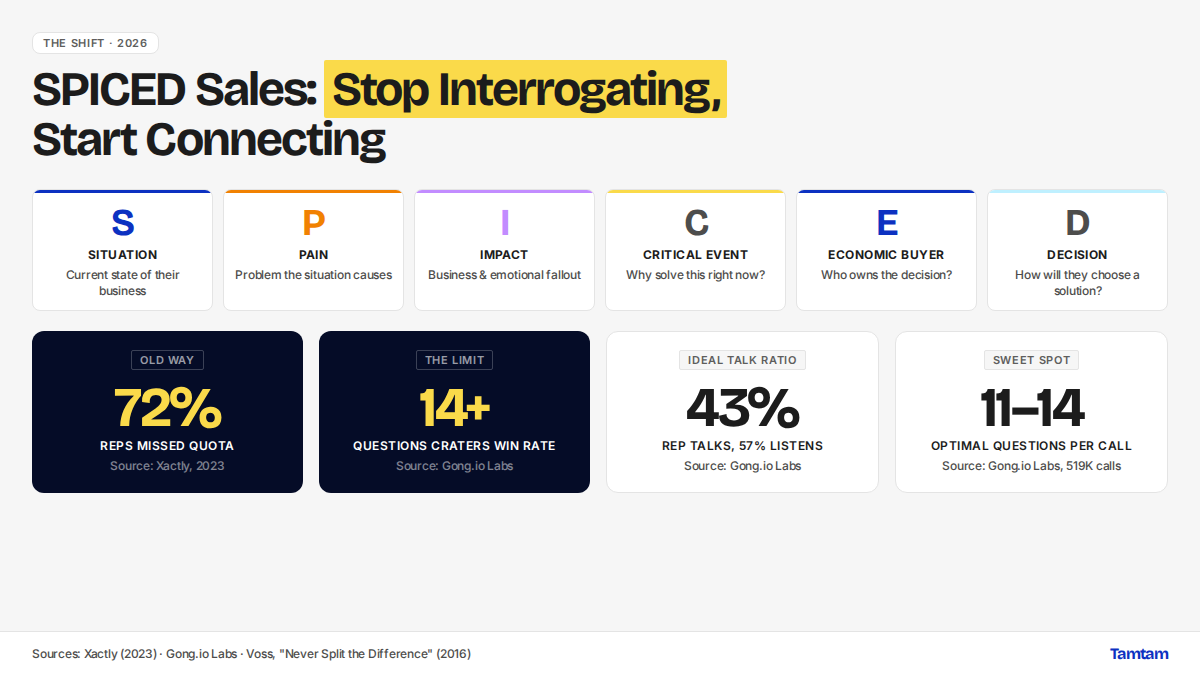
SPICED is a decent framework for complex B2B deals, but most sales teams misuse it as a rigid script, turning discovery calls into interrogations that kill win rates. Data shows asking more than 14 questions is a fatal mistake. Instead of forcing reps to follow a checklist, top performers internalize SPICED for prep and analysis while prioritizing tactical empathy and natural conversation on the call. The ultimate goal is to understand the human behind the deal, not just populate CRM fields.
Your CRM looks perfect. Every field for the latest enterprise deal is filled out. Situation? Check. Pain? Check. Impact, Critical Event, Decision Criteria? Check, check, check. According to the SPICED framework your VP of Sales loves (like every one of the other sales methodologies that promises predictability), this deal is qualified. Your forecast looks solid.
There’s just one problem. The prospect has gone completely dark.
Sound familiar? This is the quiet catastrophe happening in sales teams everywhere. In our quest for clean data and predictable revenue, we’ve armed our reps with acronyms like BANT, MEDDIC, and SPICED, demanding perfect CRM hygiene to feed our forecasting models.
On paper, SPICED makes sense. It’s a roadmap for understanding the buyer’s world:
The framework itself isn't the problem. The problem is that we've turned it into a weapon of mass interrogation, creating a monster: the data-entry rep. A rep who is fantastic at checking boxes but incompetent at actually connecting with another human being. They're so focused on the next question in their script that they miss the hesitation in the buyer's voice, the unstated political landmine, the one "Black Swan" of information that the entire deal hinges on.
And the numbers are grim. According to Xactly, a shocking 72% of sales reps missed their quota in 2023, while many companies hit their overall revenue goals. This means a handful of stars are carrying the team while the majority struggle. The old advice to just "stick to the framework" is creating a generation of reps who can't read the room.
SPICED is a map, not a paint-by-numbers kit. Let's break down the common approaches to discovery and find a better way.
This is the default setting for most teams. A sales leader learns about SPICED, gets excited about standardization, and drills it into their team as a non-negotiable script for every discovery call.
Imagine your rep on a call. They've covered S, P, and I. Now they need the C: Critical Event. They ask, "So, what's the critical event driving this project?" The prospect, a busy VP, doesn't think in sales-framework jargon. They get confused or annoyed. The rep, bound by the checklist, asks again in a slightly different way. The rapport evaporates. The CRM gets its data point, and you lose the deal.
Instead of blindly following an acronym, this approach looks at the quantitative data behind what actually wins deals. It's less about what you ask and more about how the conversation flows.
This approach, popularized by former FBI hostage negotiator Chris Voss, argues that the most critical information in any conversation isn't what's said, but what's unsaid. It's about uncovering the hidden fears, motivations, and office politics that are the real deal-killers.
Think back to that ghosted VP. A rep using tactical empathy would notice the tension in their voice when talking about the project timeline. Instead of plowing ahead, they’d pause and label it: "It seems like you're under a lot of pressure to get this done." The VP exhales. "You have no idea. My neck is on the line for this." Boom. You just uncovered the real motivation, something no "P for Pain" question would ever find.
This is the street-smart approach championed by sales leaders like Kevin Dorsey. It's about using pattern recognition and mental shortcuts (heuristics) to get to the core of the problem quickly and establish credibility without a 20-question interrogation.
| Approach | Primary Goal | Rep's Mindset | Key Metric | Buyer Experience | Best For |
|---|---|---|---|---|---|
| Checklist (Rigid SPICED) | Data Collection | Interrogator | CRM Fields Completed | Feels cross-examined | Transactional sales, junior reps |
| Data-Driven (Gong) | Conversational Balance | Analyst | Win Rate | Feels productive | All teams (foundational) |
| Tactical Empathy (Voss) | Human Understanding | Negotiator | Uncovered truths | Feels heard | Complex enterprise deals |
| Heuristic (Dorsey) | Efficient Diagnosis | Consultant | Time to pain | Feels understood | SDRs, initial discovery calls |
This isn't about picking one winner. It’s about building a modern discovery process that layers these skills intelligently. The best sales teams treat this as a maturity model.
Step 1: Redefine the Tool's Purpose. The single most important decision you can make is this: banish sales frameworks from being used as a live script. Effective immediately. SPICED and its cousins are a map, not a GPS. Use it for pre-call prep ("What do I need to learn to fill out this map?") and post-call analysis ("Based on the conversation, what did I learn, and where are the gaps?"). This simple shift changes coaching sessions from "Did you check the box?" to "What's the real story here?". In the call itself, the rep's only job is to be present.
Step 2: Coach to the Numbers First. Use the Gong data as your non-negotiable foundation. Get a call recording tool and start tracking the basics. Is your rep asking 12 questions or 25? Are they talking 40% of the time or 70%? Fix this first. This isn't esoteric sales theory; it's basic conversational physics. It's the fastest way to stop actively annoying your buyers and has the biggest immediate impact on performance.
Step 3: Layer in the Advanced Skills. Once your reps have mastered the quantitative basics of a good conversation, start teaching them the qualitative skills. Introduce tactical empathy with role-plays focused on mirroring and labeling. Teach them how to formulate "Bucket Questions" for your top three ICPs. These aren't just tricks; they're tools for building genuine connection, which is the only sustainable competitive advantage you have. This gives them the tools to be agile and adapt to whatever the buyer throws at them.
Stop treating your sales reps like data-entry clerks. The reason they revert to feature-dumping or sound like robots is because we've drilled all the humanity out of them with rigid process worship. SPICED isn't the enemy; using it as a cognitive crutch is. The real art is giving reps the freedom to have a genuine conversation, but that freedom is terrifying if they don't feel prepared. A rep's confidence comes from knowing they are talking to the right person at the right time for the right reason. When their lead list is full of accounts showing clear, recent signals of need, the conversation shifts from an interrogation to a consultation. That's why platforms like Tamtam focus on building prioritized lists based on what companies are actually doing, not just who they are, giving reps the context they need to drop the script and just talk.
Set up for you before our first call
Book a demo