June 17, 2026
Most sales teams misuse website visitor identification tools, turning them into a firehose of spam that alienates potential buyers. Reacting to a site visit with a creepy "I saw you" message instantly kills deals. This intelligence-first approach shows you how to treat intent data as a clue, not a command. By using a structured research framework to understand the "why" behind the visit and crafting relevant outreach, you can turn anonymous signals into quality pipeline without destroying your brand.
You’re paying a fortune for a website visitor identification tool. It’s supposed to be your secret weapon, the magic box that turns anonymous clicks into commission checks. So why is your team just using it to generate more noise and piss off your entire addressable market?
Because you’ve been taught to use a sniper rifle like a sledgehammer.
You see a company name pop up in your feed, and the sales floor erupts. "Hot lead! They were on the pricing page! Go, go, go!" Your SDRs scramble, find a few contacts on a social network, and blast out a dozen generic emails that all start with the same creepy line: "I noticed someone from your company was checking us out..."
And just like that, you’ve taken a spark of curiosity and smothered it. You’ve taken a valuable signal and used it to confirm every negative stereotype a buyer has about salespeople.
It’s time to stop. Your intent data isn't the problem. Your process is. Here’s how to fix it.
The single biggest mistake sales teams make is interpreting a website visit as a "hand-raise." It's not. It's a whisper. It's a faint signal from a distant star.
Your first job, and the most important mindset shift you need to make, is to go from "LEAD!" to "Hmm, interesting." An anonymous signal is the start of your research, not the end of it.
Why does this matter so much? Because immediately pouncing on a visitor triggers a powerful psychological defense mechanism called reactance. When people feel their freedom or autonomy is being threatened, they instinctively push back. The "I saw you were on our site" email is the digital equivalent of a stranger walking up to you in a store and saying, "I've been watching you browse the cereal aisle." It's invasive, unsettling, and makes the buyer feel surveilled, not helped. They will instinctively shut down, delete your email, and maybe even block your domain.
You destroy trust before you even have a chance to build it.
Imagine a VP of Marketing. Let's call her Sarah. Her team is struggling with project management, so she quietly spends 20 minutes one evening browsing three different software solutions. She clicks around your pricing page, looks at a case study, then closes her laptop. The next morning, her inbox contains this gem:
Subject: Our Project Management Tool
Hi Sarah,
Noticed someone from your company was on our pricing page yesterday. Looks like you’re in the market for a new solution!
Got 15 minutes to chat this week?
Sarah’s reaction isn't "Wow, how helpful!" It's "Ugh, creepy." She feels exposed. Instead of being intrigued, she’s repelled. She immediately disqualifies your company, not based on your product, but on your process. That’s the boomerang. You threw out a message hoping for a meeting and it came back and knocked your brand right out of the deal.
Common Mistake to Avoid: Automating outreach based on a single website visit. This is weaponized incompetence. It scales the very behavior that makes buyers hate you. Don't do it. Ever.
A website visit is just a symptom. It's the part of the iceberg you can see. Your real job is to uncover the 90% that’s lurking below the surface in what’s called the Dark Funnel.
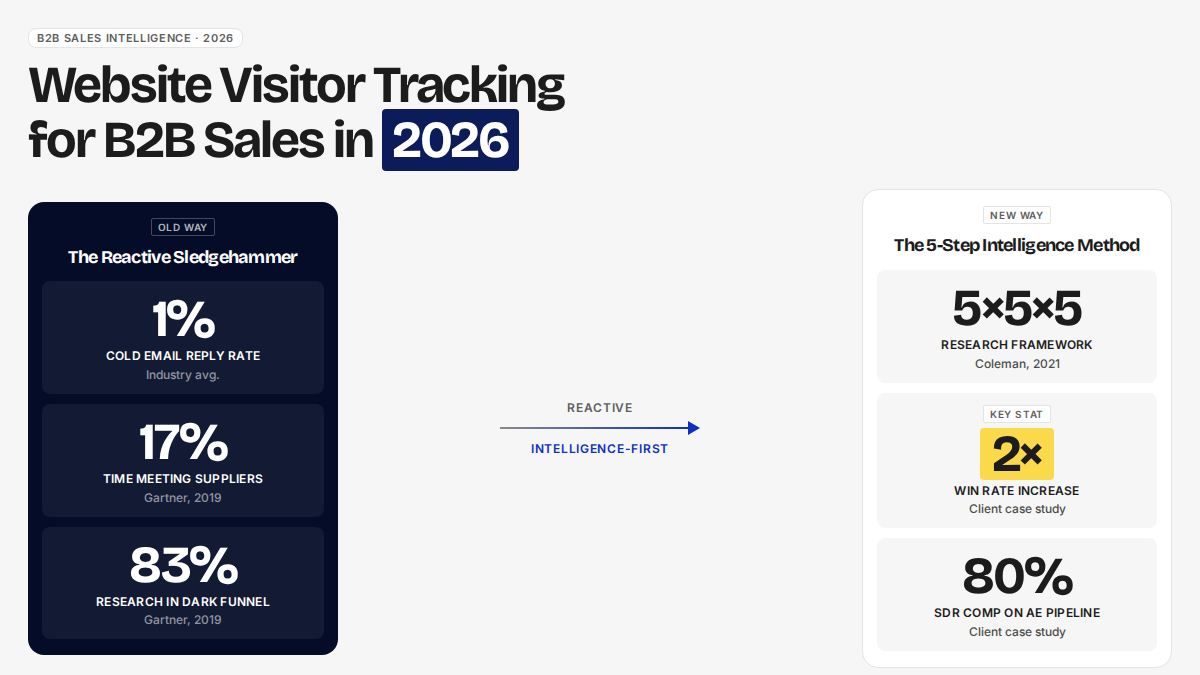
This is all the research, consideration, and conversation that happens in places you can't track: peer-to-peer chats on social networks, internal Slack channels, podcasts, and private communities. According to Gartner, buyers spend only 17% of their time meeting with potential suppliers when considering a purchase. The rest of the time is spent researching independently. Your website visit is one of the final, visible steps in that long, invisible process.
So, instead of just reacting to the what (the visit), you need to find the why. You have to play detective. Connect the signal to a story. Ask yourself:
Outreach that references this broader context instantly separates you from the 99% of reps who just lazily mention the website visit. It shows you’ve done your homework, you understand their world, and you’re a serious professional who might actually be able to help.
This isn’t about guessing. It’s about building a hypothesis based on evidence. Suddenly, you’re not just an SDR with a quota. You’re an intelligence analyst with a mission: find the story. And that’s a hell of a lot more empowering.
"Do more research" is useless advice. It's like telling a lost person to "try harder to find their way." It’s vague and leads to reps either doing nothing or spending 45 minutes falling down a rabbit hole for a single prospect.
You need a system. A simple, time-boxed ritual that makes intelligence-gathering scalable.
Enter the 5x5x5 Method, popularized by sales leader Kyle Coleman. It’s brutally effective in its simplicity:
That’s it.
This framework is genius because it solves two problems at once. First, it prevents analysis paralysis. The 5-minute timer forces focus and efficiency. Second, it provides a quality control checklist. Can you find 5 interesting things? If not, maybe this isn't a great prospect to prioritize right now.
It forces your reps to stop acting like spambots and start thinking like consultants. They are no longer just sending emails. They are synthesizing intelligence and delivering a valuable point of view. It transforms a mindless activity into a thoughtful exercise.
Common Mistake to Avoid: Confusing "research" with "aimless browsing." Without a time-boxed structure like the 5x5x5, reps will get lost scrolling through a prospect’s vacation photos from 2017. The goal is structured efficiency, not unstructured obsession.
Okay, you’ve done your detective work. You have your 5 data points. Now it's time to write the message.
Your outreach has one primary job, and it’s not to book a meeting. It’s to neutralize the threat response. Every buyer’s brain has a built-in spam filter called the Reticular Activating System. It’s designed to ignore the generic and irrelevant. Your message has to get past it.
You do this by leading with observation and tactical empathy, not with a self-serving demand.
Let’s go back to Sarah, the VP of Marketing. What if, instead of the creepy email, she got this?
Subject: Question re: project management
Hi Sarah,
Saw that your team is hiring for three new project managers. Congrats on the growth.
Usually, when teams scale their project management function that quickly, they start running into challenges with cross-departmental visibility.
Not sure if that’s a priority for you right now, but thought I’d share a case study on how [Similar Company] navigated that exact issue.
Worth a look?
Look at the difference.
This message isn’t about tricking someone into a meeting. It’s about starting a conversation by demonstrating relevance and respect for their time. It’s how you bypass the brain’s filter and get a thoughtful reply instead of an instant delete.
This is the hard part. This is the leadership move.
Steps 1 through 4 are useless if your organizational structure punishes reps for doing them. And if you’re still measuring and compensating your SDRs based on raw activity (dials, emails sent), you are punishing them.
If you measure activity, you will only get activity. Mindless, low-quality, brand-destroying activity.
This is a classic organizational disease known as the McNamara Fallacy. It’s the tendency to measure what is easily measured (dials) instead of what is truly important (pipeline quality). It’s a cancer on sales floors, and it’s the root cause of the problem you're trying to solve.
To cure it, you must perform surgery on your KPIs and compensation plans.
Abolish targets for raw activity. Stop celebrating the rep who made 150 dials. Start rewarding outcomes. Shift your compensation to be heavily weighted towards Sales-Qualified Leads and, most importantly, AE-accepted opportunities.
When an SDR only gets their full commission after an Account Executive formally accepts their lead and converts it into a real sales opportunity, everything changes. They are now financially incentivized to do the deep work in Steps 1-4. They stop carpet-bombing your TAM and start acting like strategic portfolio managers, carefully curating a small number of high-potential accounts.
A cybersecurity firm we know did exactly this. They killed their dial and email quotas. They shifted their SDR comp plan to be 80% based on AE-accepted pipeline. The first month, activity plummeted. The VP of Sales was mainlining antacids and questioning all their life choices. But by the end of the quarter, their SDR-sourced win rate had more than doubled. They were creating less noise, but far more value.
This is the move. It’s scary because you lose the illusion of control that comes from a dashboard full of green activity bars. But you trade that vanity for what actually matters: high-quality pipeline that closes.
So yes, the ultimate fix is a cultural one. It's about choosing intelligence over activity. But let's be real: scaling this kind of deep research across your entire addressable market feels impossible. It requires a system built not just to find names, but to uncover the stories and triggers that make an account worth talking to right now. Getting this part right, figuring out how to build lists based on real buying signals before they even hit your site, is the final unlock. It's how platforms like Tamtam are helping teams shift from reactive chasing to proactive, intelligence-led outreach.
Set up for you before our first call
Book a demo